Showing posts with label theatre. Show all posts

Tuesday, July 31, 2018

A Rant About Unprofessional Actors (Warning: Prepare for F-bombs)

I can't help it. I'm usually not like this. I mean, it really takes a lot to get me really aggravated. Seriously, I don't even send food back at a restaurant. Sure, if there is a Brillo pad baked into the bread or a used condom masquerading as salmon in Dragon Roll, yes, I'll raise my hand and try to get the server's attention. However, there are a few things that just piss me the fuck off. (I did warn you.) Some little, some big. For example, people who don't say anything when they are trying to squeeze by you in a store. Say something. "Excuse me." "Pardon me." "Move your fat ass, buddy." Something! Don't just stand there and get all irritated because I'm not clairvoyant. And don't exhale in exasperation as you pass by. That only pisses me off more. Here's another: Drivers who speed up when I turn on my blinker. Really? You're not gonna let me in and you are five cars back? You are gonna speed up just to let me know, what? You're so important that a little freeway courtesy is beyond you? Maybe you're in such a hurry that those extra two car lengths on the 405 are gonna make a difference to you getting to Target before the rush starts? Puh-lease. Asshole. Oh, yeah, those little stickers on produce? Fuck those. You ever try pulling those off a pear or a peach? Who invented those anyway? Ugh. Oh, and then, someone had to invent special printers to make those little fucking labels AND the special machines to put the little bastards on the fruit. No wonder avocados are so expensive!

Admittedly, those are mere annoyances that I wish could be remedied by civility or, in the case of those sticker-thingies, technology. There are, however, some things that are simply inexcusable. Actors, listen up. Specifically younger actors. I would hope the old pros out there would never do this, but who knows. I'm casting a play. I have cast many plays in my day, but this was a shock. A real wake up call. I put out the requisite casting notice in the trades. About 100 actors submitted for one of the roles. I invited twenty of them in to audition. Of those twenty, ten actors confirmed. The other ten didn't bother to respond at all. I sent the ten actors (who were professional enough to respond to an invitation to audition for a play they had submitted to) their times and their audition material. One of the scheduled ten contacted me the day before the audition and asked if he could reschedule because something important came up. Fine. No problem. The day of the audition arrived...two actors showed up to audition. Seven just blew it off. No call, no email, nothing. They just chose not to show up.


Why would anyone do that? People talk and people remember. Additionally, you never know where something might lead. My own company, for example, is work-shopping this new play (the one we're casting for), we have two movies going into production, we are working on a TV series, and we are planning a theatre season for 2019. As petty as this sounds, I will remember every single person who failed to show up, didn't call or email to cancel. Sad to say, I'll probably remember them more than the people who actually showed up, gave me their all for 3 minutes and didn't get the part.

Guess who I ended up casting? The guy who rescheduled. Why? First, he killed the audition. Second, I knew he was professional and would probably treat the role and the play with respect.

The business part of being an actor is hard. Really hard. It is as difficult, if not more so, than any other career. If you called a plumber and he never showed up after confirming a time to fix your sink, would you ever call him again? If you missed half a day of work for the cable guy to show up in that asinine four hour window and he never called but just didn't show up at all (okay, maybe a bad example), you would, at the very least, be somewhat annoyed. Do yourself a favor and treat your creative career like a profession not hobby. If you truly love what you do, afford it the people in the position of getting you work the same respect you would any other professional. Don't make me have to write something like this again.

Thank you. Next!


Tuesday, December 19, 2017

Wayne's Folly, or Why You Need to Eat Your Peas

When I was a kid, my mom made me eat peas. Canned peas. They were gross. Yeah, you could blame it on the technology of canning back then or you could, like I did, blame it on my mom for cooking the already mushy, gag-inducing little seeds beyond anything remotely acceptable for consumption. I worked out this amazing con to get out of eating my peas: I started helping my mom "clean up" after each meal. I would grab everyone's silverware and the used paper napkins and take them into the kitchen for her. Silverware in the sink, napkins in the trash. Any good con takes planning. I knew, eventually, we were going to get served peas. I was prepared. Serve the peas and I was going to shovel those little bastards into my napkin and get them into the garbage before anyone was the wiser. It worked, too. For a while. Then everyone noticed that I went from complaining non-stop about how terrible peas were to cleaning my plate of them. Hum. So much for my plan. Busted on week three of the Great Pea Stratagem.

Years later, I would nervously revisit peas. Not canned, of course, but frozen. I liked them. In fact, I really, really liked them. Next came fresh peas. Then different kinds of peas. I am now a certified pea fanatic.

That's right, I'm using a pea analogy to talk about musical theatre. Boom. Mic drop. Bet you didn't see that coming.

Every playwright has their "problem plays." William Shakespeare had All's Well That Ends Well and Measure for Measure, Henrik Ibsen had, well, everything, and Stephen Sondheim had Merrily We Roll Along and Follies. Ultimately, I think every problem play can be overcome with creativity, intelligence, a great cast, and thoughtful collaboration with a deft director. Or not. In some cases, the play is not to blame, at all. The peas aren't the problem. It's how you cook them.

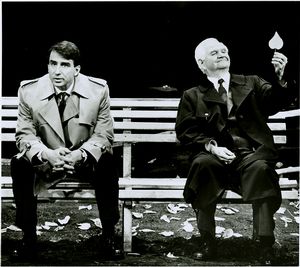
Tracie Bennett as Carlotta Campion
Follies has been, until recently, a problem play for me. I love everything Sondheim and I have seen this musical staged a few  times. Each production was - off. Was Follies a love letter to the theatre or an indictment of a bygone era? Is it about dreams deferred or the futility of hope? Is it a fantasy? A domestic drama? A psychological character study? Sure, sure, it's got a couple well-known tunes (if Streisand sings it, it must be good, right?), but I was never really able to wrap my head around it as a whole piece of theatre. Then, I saw Dominic Cooke's production from the National Theatre (thank you NTLive and Fathom Events).

Follies. Stephen Sondheim. 1971.  It debuted on Broadway and was was nominated for 11 Tony Awards and it won seven of them. One of the seven was not Best Musical.  Lights, Costumes, Scenic Design, Direction, Choreography, Score - yes. Alexis Smith won for Best Performance by a Leading Actress in a Musial. The musical itself got snubbed in what was a pretty lightweight year on the Great White Way. In it's day it was the most costly show ever produced on Broadway. It was also a financial failure, losing it's entire investment. Full scale revivals have been few and most of the notable remounts have been "concert" versions, which in my mind, while entertaining, cannot deliver on the whole of the play - the juxtaposition of one's youthful dreams against one's mature regret.

To be sure, this is a bleak musical. Beautiful, but bleak. For fear of sounding a little arrogant and old, this play is also not for young people. If you are under thirty, sorry, but you don't know jack shit about this subject matter. Which may explain why it took me so long to really understand it. As a person of a certain age, Sondheim has held a "mirror up to nature" for my generation. Maybe that's not fair. Maybe I should say, instead, that this is a play for people who have lived. Really lived. Made decisions, tripped, failed, succeeded, been scarred, been scared, loved hard, laughed loud. If you have ever questioned the very meaning of your life, ever wondered "what if?" ever thought that maybe you could have been better, gone elsewhere, done something else, seen the future, avoided the past. 


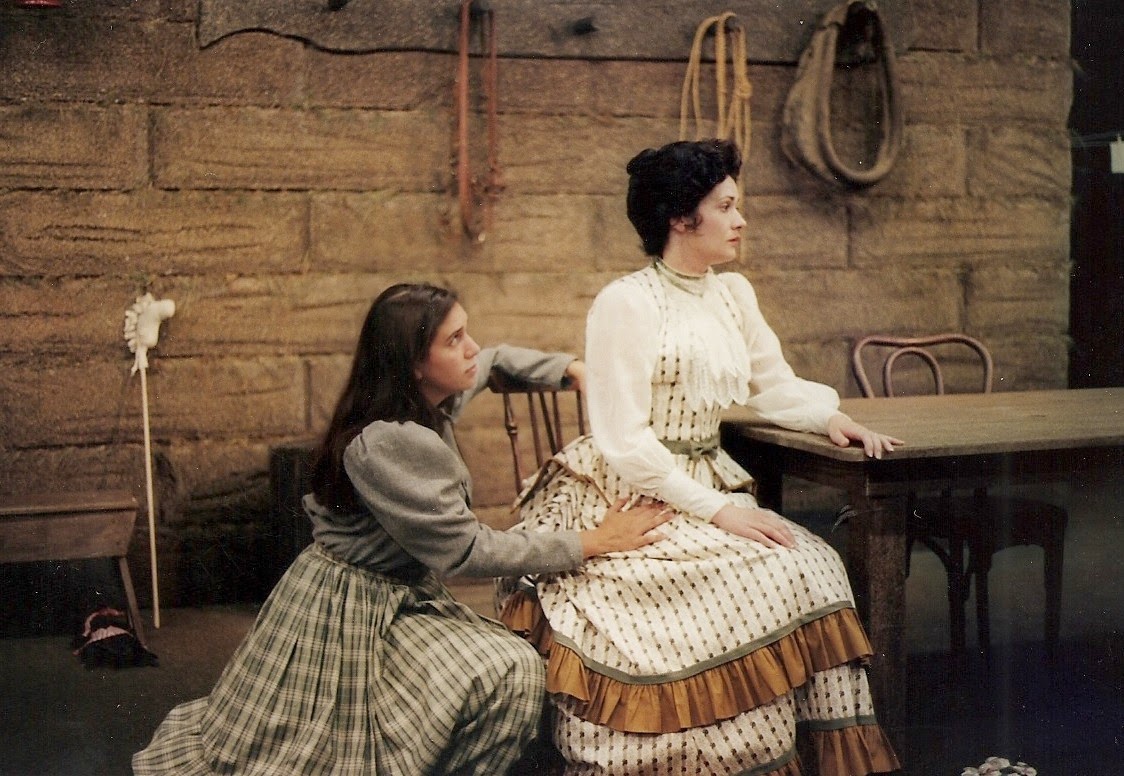
Imelda Staunton as Sally Durant and Janie Dee as Phyllis Rogers
The brilliance of Cooke's take on the play is how he weaves the ever-present younger selves of Sondheim's characters through the staging. Never a doubt that the older versions are still yearning for a "do over." Just one. Tracie Bennett's Carlotta delivers a breath-taking version of "I'm Still Here." I mean that, literally. A moment of transition in the middle of the song will take your breath away. She parleyed an exquisite piece of technical acting and combined it with a brilliant lyric. I didn't see it coming. "The Road You Didn't Take" hit me like a ton of bricks when Phillip Quast's Ben , basically, sang my own life's insecurities back at me. With each song and each line of dialog, this production uncovered an emotional experience I don't ever recall having with a musical before. Imelda Staunton's Sally will break your heart with some of the most specific acting choices I have ever witnessed. "Losing My Mind" leaves you no doubt about the characters intent or state of mind. Brilliant. The stand out for me was Janie Dee as Phyllis. It is her play. Her cynicism, her resolve, her biting disappointment. "Could I Leave You?" is a show stopper and all her. Well...her and Sondheim.

What makes the National Theatre's version of this play so remarkable is its clarity. Cooke's direction is crystal clear. He never waivers in how he presents the emotional inner workings, past and present, of the characters. There are no protagonists in this play. There are no antagonists. Everyone is flawed. It is painful. The pain and regret at the very core of this musical is at once the show's greatest achievement and also the reason it has probably failed to be a commercial success over the years. Each performer has made specific, artistically distinct choices about their character. Choices that, more often than not, do not square with other productions you may have seen.  Choices that not merely ground the character, but that also inform the other characters in the play. This is an actor's play, start to finish, and this cast shines every step of the way and the director lets them.

This is not an easy play. You do not leave the theatre hopeful and happy. You leave pondering your own life, questioning your own decisions. There is a pressure in your chest while Sondheim's music still rings in your ears. 

If you are able, go see this production, even if you think you might not like it. It's not easy to grow up. It's not easy to admit you made mistakes. Wrapping your peas up in a napkin isn't the answer, though. Eat your peas. You'll grow to like them.


Friday, April 17, 2015

Actors and Me. Musings on Fraternity.

I work with actors. Often I produce plays that have actors in them. I direct actors quite a bit. I also coach professional actors and teach young actors. Sometimes I act with actors. I have done all of these things with actors for well over 30 years. I have rarely been disappointed when doing this work.  Yes, I have a day job to pay the rent, get the suits cleaned, buy some plants for the garden and food for the fridge, and occasionally take my beautiful and talented actress wife on a swanky date. This work I do with actors does not fill my wallet. Not even close. However, these collaborations do fill my soul. They make me laugh. They make me cry. They make me think. They challenge me and make me better. Actors and the work actors undertake are one of my deep passions. I care about them. Their work, their psyche, their bodies, their voices, their health, their joy, their exuberance, their commitment, their intelligence, their opinions. Them. I care about them. Even the ones I don't much like, I still care about.

Now when I use the word "actor," I mean something very specific. I mean those men and women who are trained in the imaginative world of creating and inhabiting characters based on the written words of playwrights. I do NOT mean people who are merely celebrities. I do NOT mean people who call themselves actors but have never been on a stage or in front of a camera in a character. I do NOT mean people who, while perhaps are entertainers of some kind, have never lost themselves in the words of Shakespeare or Mamet or Miller. I do not mean talk show hosts or comics or models or media personalities or people with a website dedicated to gossip.

I AM referring to people who know how to use their voice. People who can speak properly and be heard in a theatre. Women who can project while wearing a corset and men who know how to walk on a raked stage. People who have been in a dark rehearsal room with other actors pouring over lines and movement and gestures. People who refer to a cigarette and a Diet Coke as "dinner." You know - Actors.

In my relationships with and between actors, even after all this time, I am still taken aback by the passion that actors have about what they do. Most recently, there have been two instances that have made me at once proud and so full of hope for the future of my tribe, my band of brothers and sisters, who have chosen these impossible careers.

The first is what I'll refer to as the "intimate theatre debate" occurring here in Los Angeles. For those unfamiliar with this ruckus, suffice it to say that a very large number of actors in LA are at odds with their own union about whether or not actors should be allowed to work for free (or close to it) if they so choose. The actors want to be able to make that determination for themselves. The union (Actors' Equity Association) says, no. Actors must be paid a minimum (regardless of budget or revenue) or else suffer not working under the protections of the Union. [For the sake of this post, I am dramatically oversimplifying this debate, obviously. For more info click here.] What has happened over the course of this argument may be more significant than the end results of Equity's action. The actors (several thousand of them I might add) have rallied together in an amazing display of solidarity as ARTISTS. They have communicated intelligently and passionately and (for the most part) civilly about this work they do as a community. Theatre artists and intimate theatre companies have joined their voices, and in some cases their very memberships, to support the idea that actors are special and have unique needs and requirements and consideration. From the very famous with lengthy careers to those just starting off on this arduous path -- they have joined together to control their own artistic destiny. Basically, making the case that the manner in which they pursue their art is just as important, if not more so, than money. I have never been as proud to be a member of this community as I have in the last several months. While the outcome will certainly affect me as a producer, the unity, collaboration and homogeneity of the theatre community in Los Angeles has been staggering. And beautiful.

The second occurred 1000 miles away in Portland, Oregon. Several times a year, I am asked by a few theatre companies and a couple universities around the country to come and hang out with their actors. Sometimes a couple days, sometimes a few hours. We call them "master classes" or "workshops," but I like to think of them as collaborative skull sessions where a company just gets a different perspective (mine) on their work or process of work.

Usually, when someone like me comes in to work with a group like this there is some initial resistance. I mean, let's face it, I'm not a household name in the theatre world (nor do I want to be), I don't have a book to sell, and I do not posture or pretend to be some kind of guru. I'm not. I'm just a theatre guy that has some experience and knowledge that some actors might find helpful. Hopefully, I can communicate it in a meaningful way to the actors around the table.

This particular group of actors seemed different, though. Experienced though they all were, they appeared open and available. (Each one of them also happened to be very talented, but that's a whole other subject.) I'm sure they had their questions about me. I had worked extensively with one of the actors (he's is the reason I was there in the first place), but the rest didn't know me from Adam's off ox. Yet, here they were for two days listening, questioning, applying, investigating new techniques. Challenging themselves and each other to get better, to learn, to experiment. Remarkable. And beautiful.

Two groups of actors separated by size and distance. Each proclaiming to the world and themselves that what they do has merit, is important, and should be constantly nurtured and improved upon even in the face of impossible odds.

Who does that? Actors do. And I love them for it.


Friday, March 6, 2015

The Actor: Artist or Employee

There is, once again, a debate in the Los Angeles theatre community. A big one. A serious one. The arguments are heated and passionate. Most often the headlines read: "Deathknell for LA Small Theatres," "Intimate Theatres Threatened," or "New Plan Will Decimate LA Theatres." I think the real issue is less about LA theatre and more about LA actors.

At the very core of all the heated discussion currently surrounding the AEA 99-Seat Theatre Plan, is a very simple question (well, a short one, anyway): What is an actor?
Is an actor an artist? Like, let's say, a painter or a sculptor? Or, is an actor more like a musician who picks up occasional gigs? Is an actor a craftsman? Second cousin to plumbers or carpenters? Perhaps, actors are laborers. Just blue collar working stiffs similar to our teamster friends or restaurant workers.

Now before you get all up in my grill about these categories, I know, I know...I get what you're thinking. There is some crossover with all of them and certainly the lines of demarcation aren't crisp and clear. Point of fact, at any given time, and in any given production, an actor could be any and/or all of these things at once or in any combination. Bottom line is that actors, especially those based in Los Angeles, are once again caught in this terrible gray area of what their Union leadership wants for them and what they want, or maybe need, for themselves. The division lies in defining what actors are, what they define themselves as, and whether or not the Union leadership respects and accepts that.

If actors are artists, then they must be given the opportunity to practice and create and collaborate at their convenience and with those they value and have respect for. Actors must be allowed to create projects that they feel are important or have merit free from the arbitrary calculations of what other artists do in other places. If actors are artists, then the people representing them must take that into account when making decisions that impact the practice of that art.
If, however, actors are merely part-time laborers that take a job when it happens to come around, then the rule book needs to change even more. If that definition is true (or more true, I guess) then we have a whole slew of others things that are going to have to get sorted out. Like the number of British productions coming to Broadway and touring nationally lock, stock and stage manager. Like the growing numbers of British and Australian actors coming to the States without the equivalent number of American actors working in their wake back home. Like the extreme lack of resources directed towards actually trying to help developing theatres grow beyond just demanding that they pay people at the expense of their very existence and the actors' desires.

I have been "in the theatre" most of my adult life and the vast majority of my friends and colleagues consider themselves artists.  They view their life as a creative journey that requires imagination, enthusiasm, passion, and education. They know going into it that it is going to be a tough road. They accept that. So long as they can find fulfillment in other ways -- like teaching theatre at a college, like booking a commercial or an occasional under five, like taking a role that they would never get to do otherwise at an intimate Los Angeles theatre -- everything will be okay. They can proudly and rightfully call themselves actors if they are engaged with their craft and sharing the results of their work.

Do actors want to get paid for their work? Of course, they do. Even though they know the odds are stacked against them. Just as painters want people to buy their canvases, actors want people to pay to see them perform. But painters don't paint only when they have a buyer lined up. They also don't sit around their apartments waiting for a commission. They paint. They create. Constantly. They expend time and energy and money as an investment into this obsession that is more than a job - it is a way of life. Imagine if a painter were only allowed to buy paint when he was guaranteed someone was going to buy a painting. The exact same thing holds true for the actor. In Los Angeles, that often means performing in a theatre with less than 99 seats in it. It means joining with other like-minded creatively obsessed theatre colleagues to collaborate -- to paint. 
Being an actor is a unique profession. It is unlike any other profession represented by labor unions. It is rarely, if ever, a 9 to 5 career. The coffee is worse. The uniforms change from job to job. It requires imaginative and experiential trial and error. Additionally, I think you could argue that actors are the only workers, union or otherwise, who are required to take a large part of their work home without pay regardless of contract, union status, or quality of show. Learning lines takes time. Actors do that outside of the rehearsal hall. Away from the stage. On their own time. For free. Always. That's what actors do.

The world that the actor lives in is a complicated one. It is also a unique one because, more often that we would like to admit, anyone who has an Equity card (or a SAG-AFTRA card for that matter) may call themselves a "professional" even if they have no training and little to no experience. Justin Bieber has done some TV. Mariah Carey and Britney Spears have been in movies. Jennifer Nettles is on Broadway. Does that make them actors? Does that make them artists? There's a difference between actors and celebrities.

To drill down further, each play and each each role requires specific criteria. Players are not cast for a role simply because they have a union card and are next in line. Each production or film or TV show or commercial has a litany of defining restrictions such as cast size, race, gender, age, etc. Each production, each role reduces the number of available actors by the specifics determined in the playwright's imagination. I mean, it's not like applying for jobs at a bank where a teller could be any gender, any age, and race. King Lear is old. Joan of Arc is a woman. Felix and Oscar are men. Acting is a hard, unfair and complicated business to be in. But as artists, few real actors working in Los Angeles would trade what they do for anything in the world despite all of these things.

In the 1970s, a theatre professor at Loyola Marymount University, the much loved and respected Emmett Jacobs, wrote the following in an LMU workshop program: "So often in the theatre, we are so trapped by the edifice complex and all the trappings that go with it, that we loose our capacity to do artistic research."

Artistic research.

Like painters and other artists, actors do not continue to grow because they have finished drama school or college. They do not rest on their laurels because they have finally gotten their Equity card. They do not, they cannot, create in a vacuum. Actors must get on their feet, get off book, collaborate with others, try things out, fail, adjust, try again. While money is important, it is not nor has it ever been the sole factor in why someone becomes an actor. Actors are artists.  They choose to be artists. Any changes in a small theatre plan should...must...accept that.

Monday, February 27, 2012

Why You Can't Read Plays

I was going to title this post: "Shakespeare Should Never be Taught as Literature." Then I thought some people wouldn't read it thinking it might only be about Shakespeare. Then I thought I'd be sneaky and call it "Never Read a Play Again!" in hopes that high school and college students would read it trying to get out of yet another assignment where they would have to analyze a boring drama by some dead guy who always wore a suit and tie.

Then a miracle occurred.

My wife found the following excerpt in a old theatre program. So instead of coming up with thoughts of my own this week, I'm just going to cheat and let you read what the legendary William Gillette had to say about reading plays. It's from his book, The Illusion of the First Time in Acting (New York, 1915, printed for the Dramatic Museum of Columbia University). You can get the ebook on Google Books for free. It's an excellent read for any student of acting, actual actor or theatre historian. So...read on:

"Incredible as it may seem there are people in existence who imagine that they can read a Play. It would not surprise me a great deal to hear that there are some present with us this very morning who are in this pitiable condition. Let me relieve it without delay. The feat is impossible. No one on earth can read a Play. You may read the Directions for a Play and from these Directions imagine as best you can what the Play would be like; but you could no more read the Play than you could read a Fire or an Automobile Accident or a Base-Ball Game. The Play -- if it is Drama -- does not even exist until it appears in the form of Simulated Life."

I have always railed against the teaching of Shakespeare (all plays, actually) in an English class. It is ultimately pointless. Plays are not meant to be read as literature, they are meant to be performed and seen by an audience at that moment. Each performance has the potential to be different from the night before. For the audience, and the actors, a play in performance is visceral. They are meant to be experienced then dissected. Didacticism must follow that intimacy of sitting in the dark.

Imagine trying to teach a class in cinema without watching some movies? A cooking class without food? Can't be done. Same with plays.

Thursday, February 9, 2012

Class is Only the Beginning

My acting students piss me off. I know, I know, they are probably going to read this. That's okay. They know I'm pissed off. No other artists have the utter lack of discipline as actors. Somehow, many young actors have bought into the old adage, "Learn your lines and don't bump into the furniture." Thank you, Spencer Tracy. Well, unless you ARE Spencer Tracy, you gotta do more than that. Learning your lines would be a pleasant start. But just a start.

Actually, if learning to act is just about adhering to someone's else quotes about it, then John Gielgud may have better advice for young actors, "Before you can do something you must first be something."

So many actors just starting out seem to believe that taking a class and auditioning is all it takes to call yourself an actor. (I say this having had the same misplaced attitude, lo these many years ago.) But it's what you do between classes and before auditions that make you a true actor. Does a musician just pick up an instrument a play a concert? No. There are hours upon hours of rehearsal, playing scales, practicing a particular piece of music. There's is the care and tuning of the instrument. Oh, yeah, and the rehearsal. I'm wondering if Yo-Yo Ma or B.B. King only played their instruments when a teacher was around? And when they were done playing, I wonder if they just tossed their instrument on the sofa until they needed it again. Doubtful.


Taking an class does not make you an actor any more than owning a fiddle makes you a concert violinist. But acting class is a place where you go to learn to play your instrument. Where you learn to tune it and care for it. It's a place where you pick up tips on how to get the right sound out of it; when to play fast or slow; when to play loud or soft. When to contort the strings violently to your will or when to gently stroke them. An acting class is a place where you learn how to play with other musicians in concert. How to form chords. When to let someone else take the lead and when to pull back and settle into the rhythm. It's also a place where you get to try out different styles of music in the form of scene work or monologues. Maybe for a very few, a little improvisation if it makes sense for your particular instrument or style of music.


AFTER class is over, go act. Find a play. Audition. Do something. Do another scene in class, hell, another class for all I care. Learn a new monologue on your own, memorize a whole play, whatever. There is no excuse not to pursue roles wherever you can find them. Sure, I know, you are holding out for the big pay day that a series or blockbuster film role will give you. But don't just wait around  for it to magically happen. Just like Yo-Yo and B.B., you gotta play the bars and piddly little stages. You have to work for a couple of beers or, maybe if you're lucky, a couple bucks to buy some Ramen. That's just the way it is. Those are the rules. No matter what city you are in those are the rules. Keep your trumpet polished. (Uhm, okay, maybe that one means the opposite of what I meant for it to mean.)


When actors comes to my class, there is an unspoken contract. They are agreeing that they are going to be...an actor. All in. That means they are going to do more than just show up to class. It means they are going to take everything they learned in class and put it into practice somewhere else. The class isn't the end, it's the means to an end. One of them, at least. It means they are going to learn their lines and maybe bump into the furniture until their shins bleed. Finally, it means they are going to stop listening to those that think because they are the class clown or funny at parties, that they would make a great actor. 


Let's face it, not everyone is cut out to be an actor. It takes work. Talent helps, but work separates the wheat from the chaff. (And no, I am not going to switch from music metaphors to agricultural ones. That would be too much even for me.)


Many years ago, Les Paul gave me an autographed guitar. Now, I'm not a guitar player, but I have a beautiful, un-played guitar signed by the man himself. I cherish it.  But, If I took that guitar and charged people to hear me play, it would cheat them and dishonor Lester. 

Before you go "do" acting -- "be" an actor. All in. Tune your instrument, maintain it religiously and play it whenever you get the chance. Oh, yeah, and learn your f**king lines.

Friday, October 28, 2011

Glorious Eccentricity

Right after acting school, I got a job as a waiter. Of course. But, after a couple of years of slinging tostada salads and  #2 combos (one taco, one cheese enchilada, rice and beans) I got tired of my clothes smelling like lard and my fingers like parsley. That and the fact that memorizing celebrity cocktail preferences was never my bucket of ice. (Dean Jagger did like his Ramos Fizz, though.) One day, after the perfect service of a very complicated special order, Dustin Hoffman stiffed me. Well, his wife stiffed me. Ratso Rizzo sat there and let her. That was the last burrito.

Lucky for me, I got a job at the Mayfair Music Hall in Santa Monica. The Mayfair was beautiful old girl. A delightfully garish old relic straight out of the Hollywood history books. Smelled like mold and old books. It sat boarded up for years after the Northridge quake and was finally razed a year or so ago. Very sad, indeed. My wife and I went by one day to try a swipe a brick out of the ruins but couldn't get over the fence.

The new owners at the time were trying to make a go of turning it into a legit house. Alvin Epstein directed Bud Cort in "Endgame," Phillip King performed his one-man "A Dicken's Christmas," the brilliant Jasper Carrott and the legendary Charles Piece both came in for special one-offs to pay homage to the music hall roots of the place. (If you don't know who either of these performers are, Google them. You're missing out.) And then..."Sherlock's Last Case." It was directed by the play's author, the irascible and eccentrically brilliant, or rather brilliantly eccentric, Charles Marowitz.

Charles is a critic, a director and a playwright. He is known for his outrageously, sub-text oriented, collage adaptations of Shakespeare, for his collaborations with Peter Brook, and for being one of the founders, along with Thelma Holt, of the Open Space Theatre. "Sherlock's Last Case" is easily his most successful and most well-known work. Beginning with it's world premiere at the Los Angeles Actor's Theatre in 1984 to it's re-staging in 1985 at the Mayfair and through to it's Broadway run with Frank Langella as the aquiline sleuth, the play has become a regional and community theatre stalwart. Not a brilliant play, but an entertaining couple of hours.The small cast and, basically, single set makes it possible for the most technically challenged regional groups. Doyle purists hate it, regular folk love it. Bonus points to Charles for the highly entertaining "A Background Note" in the acting script.

Regarding his approach to Shakespeare, he was once quoted as saying, "Imagine that Shakespeare's play [Hamlet in the case] is a precious old vase, and someone comes along and smashes that vase into a thousand pieces. If one were to take those pieces and put them back together, the arrangement would be new. That is, I suppose, what this (production) is. Shakespeare provides the vase and I provide the glue."  The problem with this construction method is that you take a perfectly good vase, smash it to bits and hope it holds water, or even flowers, when you are done putting it back together. Of course, with Marowitz, what he ends up with isn't Shakespeare. It's Marowitz. No matter what you think of the process or the product, he has created something new and done it with flair, panache, daring and confidence.

Love him or hate him, Marowitz is one of those guys that makes the Theatre entertaining. (emphasis intentional). For a couple of years, he wrote an immensely enjoyable blog entitled, An Actor Prepares. I haven't seen a new post for over a year now, but I hope he returns to it if he is able. He is witty, sarcastic, stern, intelligent and more  than a little opinionated. Anyone remotely interested in the stage should read a little Marowitz every once in awhile. He will help remind you why you were drawn to it in the first place. Of course, if you are like me, you may also think that he's absolutely full out it occasionally, but so what? Aren't we all?.  One of my favorite entries is one of the earliest: APHORISMS FOR THE YOUNG (AND NOT SO YOUNG) ACTOR. (I'll be stealing some of these for my Facebook updates.)


Now, Charles Marowitz wouldn't remember me from a ham sandwich (figurative and literally), but I have remembered him, followed his work and enjoyed his writings lo these many years later. The world needs more Charles Marowitz's. Those glorious eccentrics who actually have something to say and say it in their own unique way. If we don't get it, that's our problem.

Wednesday, October 26, 2011

Non-Traditional Casting: My Crisis of Conscience

I've talked about this subject before. However, a recent article in the LA Stage Times got me going again.  Here's the elevator speech if you don't want to click and read the whole thing: Joe Stern (whose work I respect very much) of the Matrix Theatre Company (a stalwart of the LA theatre scene for 40 years) is mounting a multi-racial production of Arthur Miller's All My Sons (in my opinion, one of the finest American dramas ever written).

Those who know me well, know I have long been a proponent of color-blind casting whenever possible. There are too many fine actors of color not to allow audiences the privilege of seeing them ply their craft. However, I'm am truly struggling with the application of this concept to historical works. Or rather, works that rely on a very particular set of historical or cultural circumstances that by their very essence require a particular outlook towards casting.The desire to include racial diversity in our casting decisions should never be forced or seen as a marketing strategy. It should be organic and true. It should make sense given the time, place and circumstances of the play.

Now, in the case of many Shakespearean plays, we can adapt them, bend them, twist them into a concept that supports a multicultural cast. Easy-peezy-lemon-squeezy with The Tempest, Much Ado, Twelfth Night, or Midsummer Night's Dream. But even with the Bard, there are some plays that, if done straight, just do not work unless the director conceptualizes them away from their original history and deals with that shift in a creative and justifiable way. Julius Caesar, all the Henrys, Richard III, and Coriolanus for example are real people from a particular place in history.

Now Joe Stern is no dummy. He knows what he's doing and even in the article, he specifically states the challenges he faced in casting this play the way he did. The play was written in 1947 and takes place in 1946 with World War II still fresh in everyone's mind. It is set in the Midwest, where a racially mixed neighborhood was, well, let's just say, highly unlikely. Granted, the issues examined in this play are universal and large. Which then begs the question, what does the casting do to advance the meaning of the play?

Now, I'm pretty confident, there will never be a mixed race cast of August Wilson's The Piano Lesson. Nor should there be. David Henry Hwang's first play, FOB, must be cast is a particular way. It is too specific. How are those plays any different that the Miller play? Does age make it susceptible? Are the concepts presented by the drama so large and universal that casting really doesn't matter? Just thinking out loud, I guess.

You see, for me (I think, any way...at least right this second) we have become so concerned about non-traditional casting that we fail to advance the real issue. Playwrights must write for a multicultural society. Producers must nurture playwrights of all nationalities. Film, TV and the theatre must continue to fight racial stereotypes not just by selective casting, but by play selection. The issue is really about creating for a multicultural society in the first place, instead of trying to shoe-horn multicultural casts into existing works of the theatre.

Then again, I guess what I would really like is that it wasn't an issue at all. The best actors would get the part regardless of race, color, creed, or sexual orientation. I wouldn't have to think then.

Oh yeah, go see All My Sons at the Matrix: Here's the website for tickets. Regardless of what I may think I believe at this moment in time -- this is a great play, with an excellent cast, at a theatre known for exceptional productions. I'm going. Maybe it'll help me sort things out.

Tuesday, January 4, 2011

The Falacy of Non-Traditional Casting -- I think....

This is a tough one. Not so much a rant this time as it is a continuing mind-bender that, for me at least, has no solution and never will. It also comes with this caveat: I am a white male. The vast majority of parts written are written for guys like me. This we know.

When young actors are in training, be it in college or at an acting school, there is never any thought as to limiting what characters you may someday play onstage. We are schooled early on that actors are actors and should WANT to play all different kinds of roles not just those defined by the color of our skin or our gender. In fact, many of us seek out those roles that may not fit perfectly into a typical "type-casting" scenario. We are led to believe that young leading men can play old character parts if the make up is good enough. (I mean come on, Olivier's Othello? Nailed it!) We are trained to think that the amazingly talented African American in our Acting III class is certainly capable of playing Falstaff. (A little padding here, some stipple there, viola!) How many great men of the stage have tackled Lady Bracknell? (Answer: A bunch!)

Then we are sent off into the real world. The world of types; the world of TV; the world of the Peter Principle. For years I was cast in every Neil Simon comedy on the West Coast. I was Leo, George, Felix, Sydney, Paul, you name it I played the straight, white guy. ("Straight" as in not the funny one.) But my acting school days we're still fresh in my bones. I longed for the chance to play Shylock the Jew (you'd think all my Neil Simon roles would have qualified me!), Othello the Moor (Olivier wore black-face), Tony Montana (Oh, wait, he was Cuban. Does that count as white since Pacino played him?)

The trouble we run into is that some works of theatre, film and TV really do require a certain race or gender to be cast in certain roles. They just do. Max in Bent kinda HAS to be a white male. He just does. The whole point of Troy Maxson in Fences requires that an African American male take us on that journey. And here's the part that is hard for me to parcel: Color blind casting only goes one way. Which really means it's not really color blind. Seems kinda like affirmative action for actors. Now, I am NOT suggesting we do away with affirmative action. I'm just saying that with actors, with the theatre, with all things of a creative nature, it seems like it should be different conversation. It just seems like we shouldn't even be talking about it. Of course, we can mount an Asian version of a Tennessee Williams play; Of course, James Earl Jones can play King Lear; Of course, Lawrence Olivier can play Othello; Of course, Macbeth can have an integrated cast.

Let's face it, casting Shakespeare plays with multi-racial casts is old news. Adrian Lester is the latest in, relatively, short list of actors of color to successfully deliver the bard (http:d.pn/fNmsCS). Even the histories are less about the actual people of history as they are the bigger issues and themes that have resulted in the passage of time. It's when we start to approach non-Shakespearean classics and contemporary works (okay, basically everything NOT Shakespeare) that we seem to get wrapped around the axle.

I think the answer lies not in trying to force race and gender issues for their own sake, but to create more diverse properties in the first place. (Tyler Perry productions are not my cup of tea, but you have to admire the fact that he is writing and producing specific new material for black actors and a particular audience. Barring a floodgate of "diversity projects" all of a sudden getting green lighted in Hollywood or produced in regional theatres nothing will change, I fear.) If we can't do that then we just perpetuate the problem. In an opening night speech by Des McAnuff, the artistic director hit the nail on the head. And while he was talking about Canada, it remains true for us in the lower 48, "Ours is a multi-racial society ... If our audiences can’t find their own reflections on our stages, as Shakespeare’s audiences did on his, we cannot possibly claim to be speaking to Canadians [or society] today.

What if we didn't worry about "non-traditional" casting and just worried about "casting?" You know, acting school style.What if we were to cast our shows with the best actors that came to the audition? I know, I know, the wheels would fall off of Hollywood and dozens of agents would be unemployed and casting directors would actually have to learn something more about acting than shirt size and hair color. But what if?

Bottom line is this: Someday I would really like to peek into an audition and have no idea what was being cast. I'd like to see all kinds of shapes, sizes and colors. I would like what I learned in my acting classes to be true. I think, anyway... (Oh, and I'd really like to see Helen Mirren play Prospero. Wait, they did that already?)

Addendum: Here's another take that's pretty good, too. A short article by Phillip W. Chung.

Saturday, September 11, 2010

"What do you do?"


My wife is an actress and an author, but like so many others she has a day job. She works for a university.

Academics are a strange lot. I'm not talking about the erstwhile fellow or part-time professor, I'm talking about the university MBA/PHD/EDD/BFD with tenure, a pension, and a office with an "Emeritus" name plate already engraved for them -- for when their colleagues deem them too old to stand up in class anymore. I'm talking the theatre professor who hasn't been on stage since the 60s and still directs his majors in the same plays year in and year out. The history prof who hasn't changed text books in twenty years. The communications prof who still believes everything can be explained by a pie chart. They think of the world -- no they live in a world totally devoid of the kinds of things regular people must involve themselves in. Change, for example. Risk and danger. Fear of failure. They define things. Pigeon-hole people. Believe that you believe the way they do without any discussion. (Yes, I'm generalizing. No letters, please.)

Recently, while at a campus event with my wife, I was introduced to a former "department chair." Dr. Somebody-or-Other." Very dapper older gentleman. Tweedy. Stereotypical Mr. Chips type -- only mean looking. He extended his hand, introduced himself and his credentials. I took his hand and replied with a, "Pleased to meet you, Dr. Blah-Blah-Blah. I'm Wayne Watkins." [Quick aside: Whenever I introduce myself, I always flash on the scene from Holiday Inn when Bing Crosby as Jim Hardy meets Marjorie Reynolds as struggling actress Linda Mason for the first time. Her line reading of, "I'm Linda Mason" is priceless.] His response was, "Uhm, yes, what do you do?"

But something in Dr. Whose-Its tone of voice offended me. Made me prickly. I was in a perfectly fine mood until then. It was as if no matter what my answer was going to be, it wasn't going to be as important or as meaningful as what he did. What did he mean "What do you do?" And what exactly does he do anyway? I do lots of shit! What's it too you? Oh, and by the way, bow-ties only look cool on Dr. Who and George Will! Crap. I fell for it hook line and sinker.
What do I do? What do I do? What do I do? I've heard and, indeed, been asked that question a thousand times in my life. No, two thousand. Invariably, I have always answered it with whatever it is that is occupying the majority of my time at that moment. "I'm an actor" or "I'm in the music industry" or "I'm an Artistic Director" or "I'm between engagements at the moment." No biggie? No, biggie!

When I was a young actor, Don Richardson made us read all kinds of non-acting related books. [I really should say "non-theatre related" books. As it turned out, everything is related to acting. Everything.] A series of books by Robert Audrey were particularly important to me as both a young actor and as a 20-something entering the real world of work and money and survival. One book, The Territorial Imperative, remains on my suggested reading list for my acting students. The book begins, "A territory is an area of space, whether of water or earth or air, which an animal or group of animals defends as an exclusive preserve. The word is also used to describe the inward compulsion in animate beings to possess and defend such a space. A territorial species of animals, therefore, is one in which all males, and sometimes females too, bear an inherent drive to gain and defend an exclusive property."

My new friend, this "academic," guards his territory with a vengeance. Unlike most regular folks who shuck and jive and bob and weave through life, the academic has a very well defined world laid out before him. teaches the same classes to different faces. Does one thing and defines his existence by the letters after his name and tries to do the same to give order to the rest of the world. But my world and his are light-years apart. Same planet, different universes. In my world, there is no line in the sand dividing my experiences with my knowledge. To paraphrase a line from Mamet's "A Life In the Theatre," Everything you do is a part of your life. From grocery shopping to scraping gum of your shoe. From the mundane to the dangerous. Your whole life is made up of everything and everyone you have ever seen, touched, felt, known, experienced. So to be asked, "What do you do," is no less than an invitation to tell your life story.

Now, I feel confident Dr. Doo-Dad didn't really want to know my life story. I was in his building, he was the Alpha Dog and he simply wanted me to know that. He didn't care all that much about me either way -- he was just being "polite." Perhaps he really wanted to know where I worked. As in, "What do you do for money?" Guess I should cut Dr. Bow Tie a little slack.

But, I must say, I think my answer will change now and forever. What do I do? I do lots of shit...and so do you.


Friday, March 19, 2010

Standing Ovations


"The Subject Was Roses" is playing here in Los Angeles at the Mark Taper Form. The play was written in 1964 by Frank Gilroy, won the Pulitzer, was on Broadway where it won a Tony Award for Best Play and was made into a film.This particular mounting was put in motion by it's star, Martin Sheen. Sheen was in the original Broadway production and nominated for  Tony and Jack Albertson won the Tony for his portrayal as the father -- the role Sheen inhabits today. It's a homecoming of sorts for Sheen.

Two things need to be said right off the bat: I'm a huge fan of both the Taper (It's great space and I am rarely disappointing in the productions) and of Martin Sheen. Pound for pound he is one of My favorite actors of all time. Missiles of October, Apocalypse Now, The Execution of Private Slovak, Da, That Championship Season. Those films alone put Sheen in my books as one of our best actors. Then, of course, there's The West Wing. Not just a masterpiece of television drama by Aaron Sorkin, but a brilliant cast lead by Martin Sheen as President Jed Bartlet. Sheen's President Bartlet spoiled me for any other President in my lifetime. But I digress....

Liz and I always love going to the Taper. We'll usually have dinner and drinks al fresco at the Pinot Grill just outside the Taper doors. We'll saunter in with the other patrons, take our seats and let the play wash over us. All of this we certainly did on this evening. The play was good enough. Just good, not great. Most people probably came to see Martin Sheen live and in person on stage. fair enough. And Sheen was fine. Frances Conroy as the wife and mother was fine. Brian Geraghty (from the Hurt Locker) was obviously green and needed a firmer hand from the director, but serviceable enough considering his relative lack of theatrical chops. The set was fabulous! Later, our ride home would be filled with an intense discussion about why this play was chosen, how we would have addressed some of the problems we saw, etc. You know, the kind of stuff all theatre folk tear apart and chew on when we go see a play. But, all in all, a pleasant enough evening at the theatre. We enjoyed it.

Then the play ended. The applause started and everyone stood up. Not to leave, but to applaud. A standing ovation.

Now I can count on one hand the number of times I have been in the midst and a willing participant in a true heartfelt standing ovation. A performance so enthralling or so fabulously moving no one present would have even known they were rocketed to their feet by some unseen force of the theatre. Antony Sher as Richard III at the RSC in 1984. Kenneth Branagh as Henry V that same year, same place. Ian McKellan in his one-man show Acting Shakespeare at the Westwood Playhouse (now the Gefffen). No question: Standing O. Brilliant, moving, tours de force, passionate, exquisite, nonpareil. Whole theatres on their feet in a flash, knowing they had seen something truly special.

Since then, however, and particularly over the past ten or fifteen years, I've noticed that audiences will bestow a standing O on anything they pay money to see. Liz and I have been the only one's seated at some of the most mediocre plays and performances of the last millennium. We have seen dreadful celebrity performances bring the house down. We have witnessed $100 a seat musicals receive standing ovations, yet not a single tune was whistled fondly on the street afterward. What gives?

Has the sheer price of tickets made us believe that what we are seeing is spectacular? Have we become so enthralled by celebrity that we will always stand for star because he or she is in the movies? Do we just not go to enough theatre to know good from bad? Are our expectations just so low that we are simply amazed that poeple can learn that many lines?

I'm worried. The standing ovation at the Taper could not have been for the performance that evening. It was fine. It wasn't fabulous. It was journeyman work. It wasn't transcendent. The only explanation must be that Martin Sheen is famous. So we should stand for the famous guy. 

I rarely agree with reviews. But for once I agree with a review in the Hollywood Reporter. It is a fair assessment of this production. Some of it is the fault of a dated play that just doesn't mean what it once did. Gilroy's play has become a period piece. Some of the fault should fall at the feet of the director for not doing more to address the play itself and for not guiding a young actor better through the minefield that is live theatre. But most of the fault lies in the clapping hands and standing bodies of audiences that demands nothing more than a nice evening out.

I hope to see a play soon that will force me to my feet without a second thought. Indeed, I long for the rush that fills my head and face as I stand in awe of a massive display of talent and words and collaboration to powerful that my very being is catapulted from my comfort. Until that show comes around, however,I will continue to enjoy my play going with my wife and friends. I will continue to work in and support the theatre and the artists who work in it. I'll just do it from the comfort of my seat.

Monday, March 1, 2010

Robert Prosky


You might not know the name, but you certainly know the actor. Robert Prosky is one of those actors whose career I have always respected... and coveted. First of all, he was a gifted actor. Second, most people would not recognize him if they bumped into him in the produce aisle. Some might do a double take thinking he was a distant uncle or former school teacher. If you were to ask me to "type" him, I guess I would say he is like a softer version of Ed Asner. He generates the same power with less bombast. 


Prosky died in 2008 at the age of 77. He was an actor that did everything: Stage, films, television. "Either for tragedy, comedy, history, pastoral, pastoral-comical, historical-pastoral, tragical-historical, tragical-comical-historical-pastoral, scene individable, or poem unlimited: Seneca cannot be too heavy, nor Plautus too light." I had the pleasure of seeing him in A Walk in the Woods. Sometime ago Actors' Equity sent the following Robert Prosky missive in the mail to all its members. (I came across it while catching up on some filing I promised my wife I would get around to back in 2009.) I have shared it just as Equity had sent. I'll bet the capital "A' in Actor was Prosky's.


"I love Actors and by extension, the theater. I love the minutia that surrounds them both. I love listening and telling Green Room war stories. I love the onstage triumphs and yes, I love even the disasters. I love the adrenaline that shoots thru every Actor onstage when something goes wrong, and the relief that sweeps thru when some heroic Actor saves the day. I love performance. That time when the human beings on stage interact with the human beings in the audience and together they create the event of performance. It's one of life's most civilized experiences.


It has been said that an Actor must have the hide of a rhinoceros, the courage and audacity of a lion, and most importantly, the fragile vulnerability of an egg. It also has been said, and I'm not sure by whom, that the moment of not knowing is the moment that has the greatest potential for creativity. The professional and private lives of most Actors are filled to the brim with moments of not knowing. Actors are survivors and will continue to strive because they have the need to celebrate, in performance, that sacred communion between Actor and audience."


Amen.


Thursday, February 18, 2010

An Acting Coach Prepares

A student recently asked me why I don't "write more about acting" in this blog. I sighed. I have failed. [Hanging head in shame.] Apparently, my sessions are not hitting home. At least for this young thespian.

As if the art and craft of acting is like learning your times tables, young actors continually look to people like me for secrety secrets that will make them famous. Coded formulas that will make them "good actors." Let's just memorize some lines, the rest will just manifest itself once in front of the camera or on stage. As if there are little pills they can take that will transform them into theatrical superheroes able to leap tall verse in a single soliloquy. Agents, seeing their new found prowess will sign them, send them on the perfect audition for the next big time and -- viola -- they are living in Beverly Hills with a chihuahua and a Bentley convertible. Or at the very least, a black lab and a Lexus SUV. Sigh.

Young man, you gotta do the work. What is the work? Life. Life is the work. There. I said it. Save your money, quit your acting classes. You now have the knowledge that all great actors throughout time have known before you.

As a young actor, I too, wanted a fast track to fame. Impatient. Ambitious. Arrogant. "I was PERFECT for that role, I nailed the audition, whatdya mean I didn't get a call back?" The fact is, not everyone can do this acting thing. Not everyone has the patience or the intestinal fortitude (never used that phrase in a written sentence before!) to study acting. Study, I said. Actually, you don't really "study acting." If you did that you might more readily be considered a critic. Actors study life. By applying their observations they become actors.

Like some cosmic soap box derby, most humans coast through life. For some the road is steep with treacherous turns and uneven surfaces. For most, the journey is straight, even and flat with hedges and soft shoulders lining the way. Maybe the occasional bump or pothole. The actor's job is not just to coast on whatever his path may be, but to constantly stop and start. Survey the landscape, test the wind, smell the flowers, change cars, crash, steer into the ditch.

Even more, the actor's job is to pay attention. To everything. One of my most important mentors when a gentleman named Don Richardson. When studying at the American Academy of Dramatic Arts, Don would always assign the most ludicrous reading assignments. Articles on social anthropology, biographies of Nazi war criminals, psychology, weird shit that had nothing to do with ACTING. Or so thought a young impatient, ambitious, arrogant acting student who had yet to really pay attention in class.

While I certainly am still rather full of myself, I do know (or rather have come to know) that teaching the art and craft of acting is more than creating a stable of young people who hang on my every word. It's not about becoming a guru. It certainly isn't about the money -- at least for me. It is more than tweaking a line reading or cleaning up a goofy double gesticulation that could seriously poke someone's eye out. It's about trying to lead human beings through their lives with their eyes open. It's about helping to sift through the chatter of the insignificant and realize when it's not. It's about getting them involved in the world, in history, in culture, in art, in politics, in food, in sport,...in others.

I can't "write more about acting" any more than I can teach more about acting. I think acting coaches should be like psychiatrists. We should be in the business of putting ourselves OUT of business. We should prepare our charges for the day when they will boldly and bravely leave us. Armed with with the tools we have given them and taught them how to use.

I wonder if this will count as "writing more about acting."

Monday, November 23, 2009

Don't Confuse Celebrity with Craft.

As an acting coach, I work with quite a few young, aspiring actors, a couple older character actors and even a friend or two who, over the years, I have convinced I am a genius and they cannot do without my mystical words of wisdom every week. They are friends, so they know I'm full of shit half the time, but they still like coming in to the studio to workout and listen to me correct their diction or help with a line reading.

What I find with about 50% of my young students is a serious confusion about what it means to be "an actor." Actually, confusion isn't the right word. Ignorance, is the right word.

I posted the title of this blog "Don't Confuse Celebrity with Craft" on my FaceBook account several weeks ago. I've been stewing over it ever since. Actually, the whole post read,

Note to young, aspiring actors: "Being in a movie" is different than "being an actor." Kinda like pouring Drano down your sink doesn't make you a plumber. Don't confuse celebrity for craft.

 A very talented writer friend who happens to be a very capable actor wrote the best comment. Jed said, "...a great majority of people, particularly in that bastion of modesty known as Los Angeles, say that they want to be actors, they mean film... and what they really mean to say is, 'I want to be famous.' So, I'd have to say that MANY people who want to be film actors want to be famous, whereas most who want to be theatre actors want to work on the craft."

That is true. Too true. Probably always has been in Hollywood.

What set me off in this direction, today of all days, was my morning ritual of catching up on the news and sports and gossip and politics first thing in the morning. Do it every day. computer humming, coffee stemming, fingers dancing across the keyboard as I surf over to my Google Reader and start filling my head with...well, crap mostly -- but at least I feel like I'm staying on top of things. Today was typical. Healthcare, polls, Tiger Woods (ooo, that's good for a rant!) Sarah Palin insanity (don't get me started), local crime, check the weather, what does Tom Friedman have to say, how's the weekend box office look...and, oh, look, FHM has their new list of the 100 Sexiest Women for 2009! Sweet!

As I glance over the bios of some of these lovelies I start to notice that many of them are "reality show stars," swimsuit models, or just famous. Famous for being famous and nothing more. Some have even been in movies. One was called a "Bond Girl" because she was in Casino Royale as "Tennis Girl #1." That did it for me. Totally set me off. You are NOT a Bond Girl simply because you are in a James Bond movie. You have to at least have some lines and a really cool, sexy name given to you by the writer. You know, Pussy Galore or Holly Goodhead or Plenty O'Toole. Tennis Girl #1 is definitely not a Bond Girl name.

I was off. And I was thinking about all the young actors I have known who didn't really want to put in the work to be an actor. They wanted to be famous. Didn't care how. "How do I get on a reality show?" "How do I get an agent?" "How do I get on a soap opera?" They come to guys like me to get the secret to being famous. Yeah, like I know, right? Like anyone knows. Like I wouldn't have used it myself somewhere along the way. (You've probably noticed that Tom Cruise and Mel Gibson don't teach "Cold Reading Workshops" or "How to Make it in Hollywood.")

The business of acting is big. I'm not just talking about movies and television and theatre. I'm talking about books on acting, newspapers on acting, classes on acting, websites on acting. Acting coaches, cold reading workshops, camera technique, How to Audition, How to Get an Agent, How to Make It, How to Make It While You're Trying to Make It. Big business.

Now before you jump my ass, I know, I am as much a part of the problem as I am the solution. I'm one of those people who profess to be able to help you become a better actor. The difference between people like me (and there are quite a few, even in LA) and those out to just siphon money off of naive young people who happen to dream of being Paris Hilton's BFF is sizable.

I'm one of those assholes who wants you to leave your ego at the door and work hard, try new things, read, vote, become involved and live a passionate engaged life. I'm the deviant that will explain the difference between your job and your career, your career and your life. I also will charge you a fair price for my knowledge and if you reach a point where I think I can no longer help you, I'll tell you so and stop cashing your checks.

What we must never do as actors or as teachers of actors is to believe the hype of popular culture. We must understand the difference between Kim Kardashian and Meryl Streep. Don't get me wrong, I love Kim. She's hot! But I do not want my students to aspire to be her. What I WOULD like to see? I would LOVE to see Kim and Paris and all the other pop divas study acting as a craft. Or not

We have to turn off TMZ or, at the very least, realize it's bullshit meant to feed a hunger and not the real world of an actor. Celebrity is not acting. Acting can sometimes (rarely, I might add) lead to celebrity. Stay true, learn your craft, expect to have many jobs that aren't acting. Continue to dream? Most definitely. Continue to study your craft? But, of course. Just know that Paris Hilton will probably never play Ophelia in summer stock and Ryan Seacrest would make a terrible Sergius Saranoff.

Wednesday, April 8, 2009

Back from the abyss -- An Actor Prepared.


It's been quite some time since my last rant. Part of it comes from finding the time to make this blog a part of my schedule and part comes from just plain laziness. So for the five of you that give a rat's rosy...my most humble apologies for being absent. (And remember: A rant isn't always a negative thing. Sometimes it's a joyous romp through a field in your skivvies.)

Actually, since the election, I've had very little to rant about. I'm happy. Sure, the nature of politics still gets under my skin, Prop 8 just pisses me off to no end, the economy is scary, Iraq and Pakistan and Afghanistan are still a plague. But, hey, at least we now have a leader who can and will actually talk to the rest of the world in complete sentences. It's those baby steps that matter.

Oh, yeah, and I think I'm in love (love may be the wrong word) with a lesbian. Yes, my wife knows and kinda approves. Rachel Maddow. She's not a lipstick lesbian like you see on TV, but she's hot in an I'm-smarter-than-you-and-I-eat-Republicans-for-breakfast kinda way. Her show on MSNBC is a breath of fresh air. Watch it. But I digress....

My wife, Elizabeth, sent me a quote the other day from Charles Laughton.

"Method actors give you a photograph. Real actors give you an oil painting."

Charles Laughton was (for those of you don't know) a remarkable British actor. Died way too young as many of the best and brightest do. He also directed a movie -- The Night of The Hunter. One of my favorite movies of all time and, unfortunately, the only film Laughton ever directed. It was a huge flop at the time. Critics panned it, failed miserably at the box office. Today it is considered by many as one of the best movies of the 1950s. It features a completely terrifying performance by Robert Mitchum and a powerfully sensitive performance by the incomparable Lillian Gish. See it. But I digress....

Since about 1951 people who call themselves actors have been having a very passionate, even if not public, debate about what acting is all about. Is there an "American-style?" Is it more effective than the "British-style?" What is "the Method?" Which is better? What the difference? Does anyone care?

1951 is the year that Lee Strasberg took over as director of the Actors Studio. Under his leadership grew what is today known as "the method." So many actors actors have been influenced by the method, it really is impossible to discount utterly -- then Laughton, so simply, throws water on the fire. A photograph versus an oil painting.

For some reason, as an actor and a director, that resonated with me. What is an actors job and how does one do it? Are we out to take a picture and pass it around the audience? Or, are we attempting to use paint and canvas, color and light thereby allowing the audience to stare and wonder -- "Hum, what about THAT?"

And, too, all the arguments in the world pro and con still miss the mark I think. Even my arguments boarder on the simplistic (thank you, Mr Laughton. No, really, thank you). All the talk of "The Method" and the variety of different permutations of it (Strasberg, Meisner, Adler) still fall short of the mystery of acting.

Here's our experiment: Let's put Picasso, Rembrandt and Seurat all in a room with the same paint, canvas and brush. Gather up John Lennon, Mozart and, oh, what the hell, Kanye West in the same studio with the same instuments. Their background, world view, inherent talents, sexual proclivities, physical limitations, manner of holding the brush or fingering the keyboard, personal taste, immediate frame of mind -- will all come to play on what they ultimately produce. Everything will be unique even though the tools were identical.

So it is with acting and actors. We simply cannot boil down such a complicated personal process into a "method." With all due respect to those those who teach such things, perhaps, rather than trying to teach young actors how to become the next Brando, we should be teaching them how to become the first (their name here). Maybe we should be teaching them about the tools they have as human beings: How to breath, how to use their voice, what they can do with their body and their mind. Maybe we should teach them to read and write, to observe and participate in the world. Maybe we should teach them history and literature. Maybe we should teach them to live and love and care for things. Then, once we do that, let them discover how they wish to use this mighty, highly tuned instrument in Shakespeare or Mamet or Chekov or Simon. But, I digress....